Categories
Uncategorized

When Satellite TV Came to My Town

My first introduction to satellite television occurred in 1985. This is the year when the local cable network in my home town of Roosendaal in the Netherlands suddenly gained three new channels: Sky Channel, Music Box and TV5.1 I was 9 years old back then and as a true TV junkie I was delighted with all this new content. It was the first time we were able to see something beyond the state-owned domestic and neighbouring public broadcasters!

CATV As a Public Utility

A little background on CATV (community antenna television) and TV in general in the Netherlands in the 20th century would be appropriate here. Contrary to the US and many other countries, cable television in the Netherlands was typically a monopoly that was owned by the local government (the municipality or “gemeente” as it’s called in Dutch). When TV started becoming really popular in the 1950s, antennas started popping up on roof tops left and right and the Dutch, neat as they are, found all these ungodly rooftop antennae “ontsierend voor het straatbeeld” (spoiling the appearance of the public environment). The installations were also deemed a hazard, due to unprofessionally mounted antennas that could come loose during heavy weather conditions.

So, beginning in the 1970s most municipalities in the Netherlands started setting up their own CATV systems, which would provide superior signal quality over individual roof top antenna reception, due to the fact that reception of the signals could be done at an optimal central location (the cable headend) using professional equipment. All households in the municipality were automatically connected to the cable service, so we could get rid of all those roof top monstrosities.

The CATV service was typically operated by the local municipal electricity and/or water company. because that’s just how the Dutch viewed cable television: a public utility service, just like electricity and water. Because every household was connected, and because the service was typically not-for-profit, subscription costs were relatively low and we could all enjoy grade-A television reception. Cable television in the Netherlands was not a luxury service, it was a public utility that everyone had, rich or poor.

Shaking Things Up

Before the arrival of these new satellite channels, it was very much a dull affair. Our local cable network in 1985 had a pretty typical package of boring public broadcasters. We had the two Dutch public broadcaster channels Nederland 1 and Nederland 2, our southern neighbours the Belgian (Flemish) public broadcaster BRT1 and BRT2 and the Wallonian RTBF-1 and RTBF-2, and of course our neighbours in the east: West-German public broadcasters ARD and ZDF, and the regional WDR. This sleepy status quo was suddenly disrupted with the arrival of Sky Channel and Music Box.
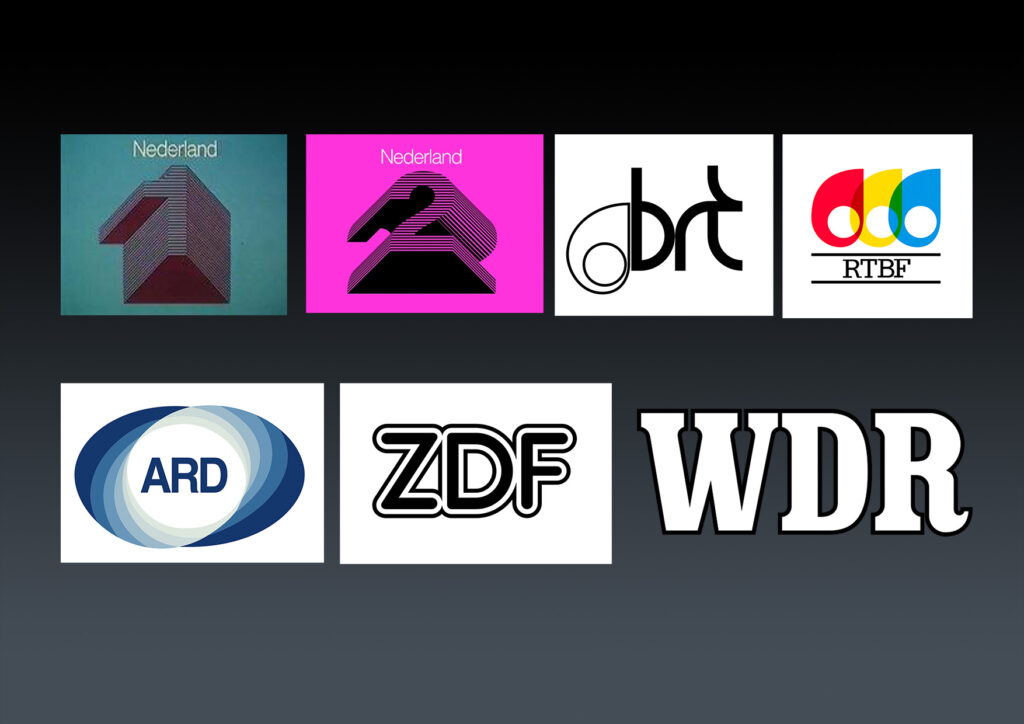
Before 1985 it was all state-owned public broadcasters on most Dutch cable networks.

Sky Channel was the proverbial battering ram that cunningly managed to break through the comfortable television monopoly the state owned public broadcasters and Dutch government had maintained for decades, and in the process opened the flood gates for many more satellite television channels to follow. After being denied access to Dutch cable networks for years (ever since their launch under the name Satellite Television in 1982), they finally got the break they were looking for on May 4th, 1984 when the Dutch authorities finally relented and confirmed they had “no objections” to inclusion of Sky Channel on CATV in the Netherlands. Almost overnight Sky Channel doubled the number of households that could watch the channel in Europe, due to the more than 700,000 new Dutch households that were connected on May 5th.

Unfortunately my hometown Roosendaal was not among the municipalities that got Sky Channel in May 1984. Our cable headend lacked the channel capacity and also did not have the necessary satellite reception equipment. At the municipal council meeting of November 29th, 1984 the council voted for increasing the CATV budget so that the responsible municipal cable headend operator  Gemeentelijk Energie en Waterleiding Bedrijf (= Municipal Electricity and Water Company) or G.E.W.B for short, could invest in the necessary equipment for satellite television reception.
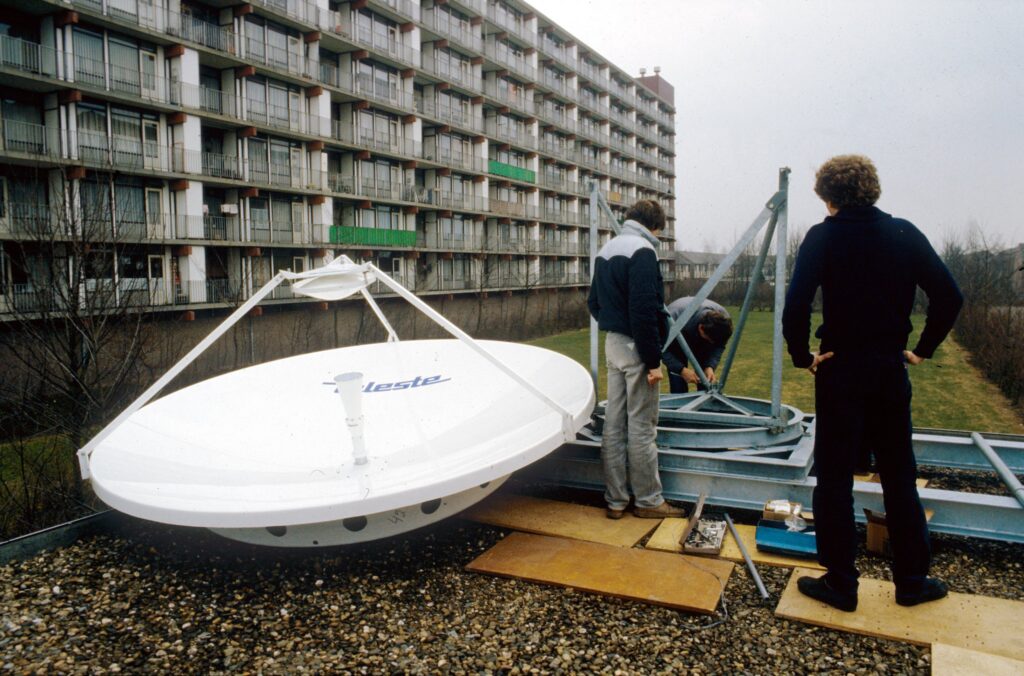
A 3m dish being installed for ECS-1 satellite reception for the Roosendaal municipal cable headend. (December 1984)

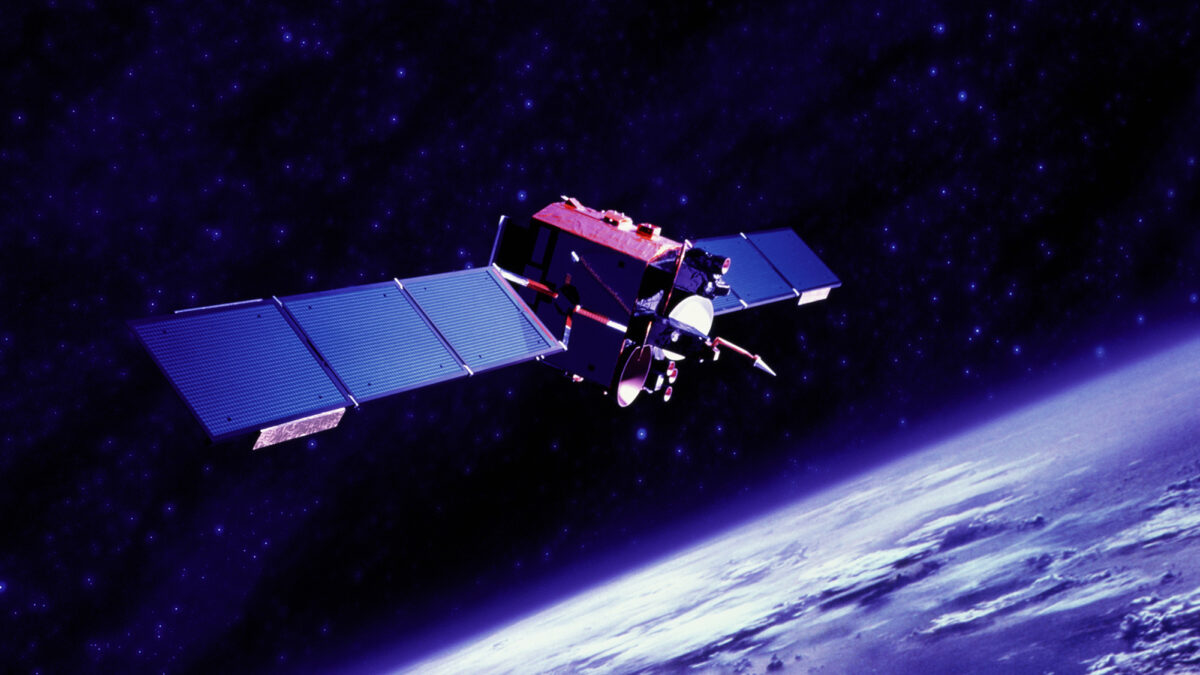
And so it was on a cold and dreary Wednesday December 12th, 1984 that my home town’s cable headend got an important upgrade. A 3 meter satellite dish was installed, pointed at the ECS-1 satellite at 13 degrees East.
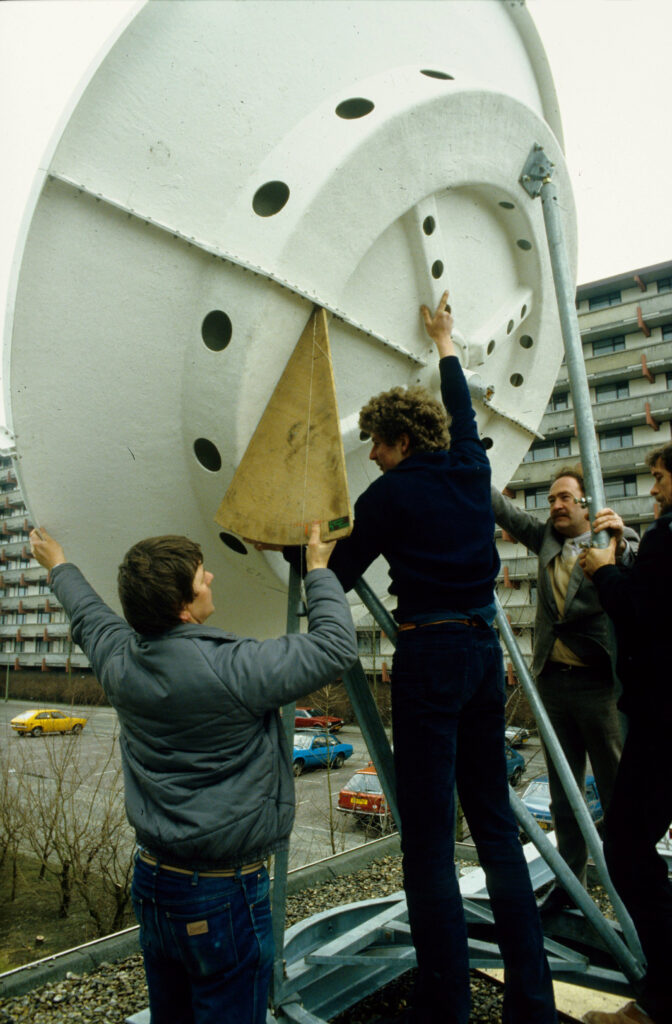
“A little more to the left, Kees.” (December, 1984)

This very satellite dish was responsible for the reception of several satellite television channels during the 1980s by Roosendaal households via cable. It provided 60,000-ish people with many hours of television entertainment delivered via satellite: Sky Channel, Music Box, TV5, Super Channel, Europa TV and pay-tv channel FilmNet.
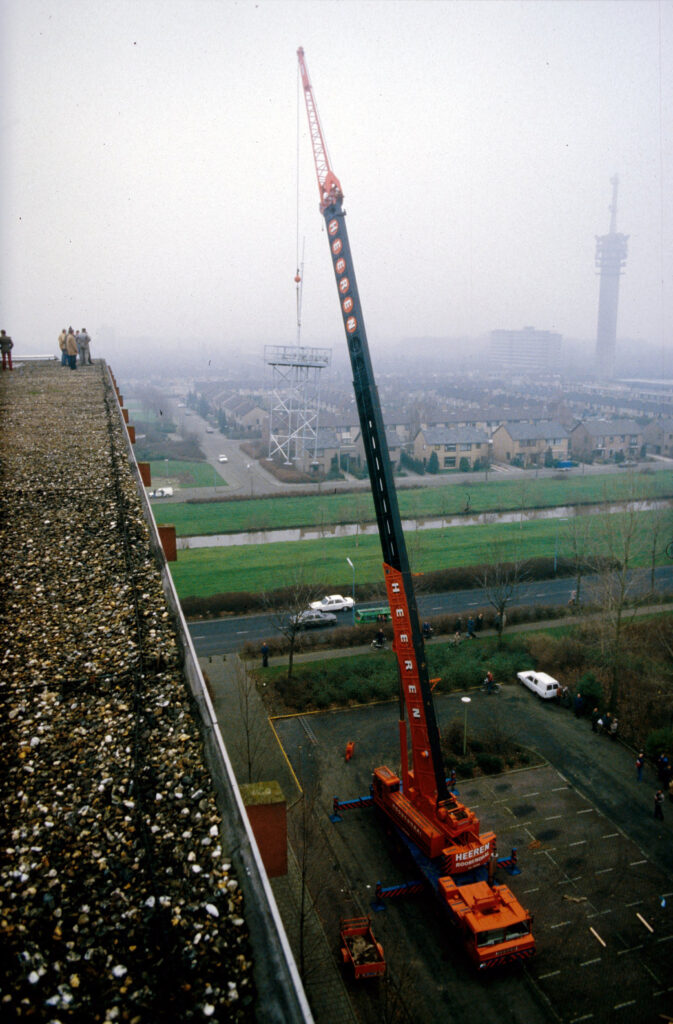
Terrestrial reception was getting an upgrade as well. (December, 1984)

I am not sure of the exact date when the new satellite channels became available on the cable net. By late March the G.E.W.B. was still negotiating contracts with Sky Channel2, but it must have been not too long after that.
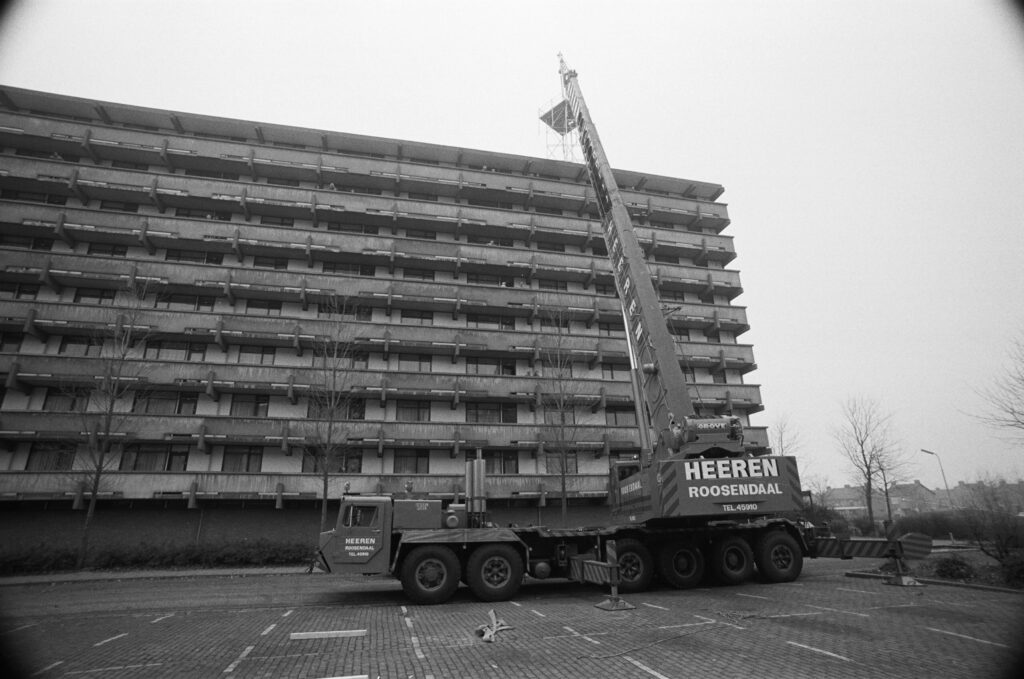
Placement on top of an appartment building guarantees better reception. (December, 1984)

Welcome to the Fun Factory

The reason I’m so sure about that is because I vividly remember watching the very first episode of the Fun Factory, a Saturday and Sunday morning children’s program on Sky Channel, which premiered in July 1985. I remember having had access to Sky Channel for a while before Fun Factory premiered.

Footnotes

  1. Technically it was two channels, because Music Box and TV5 shared the same frequency on our cable network. TV5 only broadcast in the evening hours, while Music Box basically just repeated the same 6-hour block of programming 4 times per day. Many other municipalities in the Netherlands had a similar arrangement due to limited capacity on the cable network ↩
  2. Source: Municipal council meeting Roosendaal of March 28th, 1985. ↩

Categories
Uncategorized

VideoCrypt’s Fiat-Shamir ZKT fail

Zero knowledge proofs are a way for one party (A) to prove to another party (B) that they know a secret (S). But, and here’s the very clever part, it provides a way for A to prove to B that it knows S without having to say what S is. Now why would that be useful? Well, it can be incredibly useful in electronic communications, because any potential evesdropper (C) can not determine the secret in question simply by observing the communications between A and B.

Let’s say A is a smart card and B is a decoder, and we want the decoder to be able to determine whether the smart card knows the secret S, without the decoder itself knowing what S is. If the smart card passes the test it has proven to the decoder it knows S and is a genuine smart card. If on the other hand it fails the test, the decoder knows the smart card is not genuine and the decoder will refuse to descramble the TV channel.

The Fiat-Shamir Zero Knowledge Test is an example of a zero knowledge proof scheme that is well-suited for use in smart cards1 and was implemented as part of the VideoCrypt conditional access system. But the way that the test was implemented in the VideoCrypt system resulted in a vulnerability that was easy to exploit by makers of pirate smart cards, rendering the test completely useless.

How Does It Work?

Before we can understand why the Fiat-Shamir heuristic implementation in VideoCrypt was such a fail, we need to know a little bit about how it works. Although I find the theory behind zero knowledge proofs fascinating and ingenious, it’s just a bit too much beyond the scope of this blog post to go into here.2 But basically what happens between the decoder and card is this:

  • The smart card sends a 512-bit random value that it chooses
  • The decoder sends a challenge bit (either 0 or 1)
  • The smart card returns a 512-bit solution

Based on the solution returned by the smart card the decoder can determine whether the smart card knows the secret S and therefore is a genuine smart card or whether it failed the test, in which case the decoder refuses to continue to communicate with the card and the TV channel would not be decrypted anymore.

Why Did It Fail?

The first vulnerability was due to a monumental bug in the microcontroller inside the first generation of VideoCrypt decoders that were manufactured.3 The decoder would accept any solution that the smart card would send. The card could send any 512-bit values and whether the card passed the test or not, the decoder would happily continue functioning and communicating with the card.

Photo of SVA-1 decoder

The bug in itself was not an insurmountable problem. After all, it could be fixed in future revisions of the decoder microcontroller ROM software. Given the many millions of standalone and integrated VideoCrypt decoders that would end up being manufactured over the years, this particular vulnerability would have been limited to a relatively small subset of the total number of decoders in the field. But alas, there was an even larger vulnerability which was so fundamental, that it turned out to be the final nail in the coffin of the Fiat-Shamir Zero Knowledge Test in the VideoCrypt system…

Fundamental flaw

The vulnerability that definitely put the Fiat-Shamir ZKT out to pasture was the fact that the decoder had no way of remembering previous tests, meaning the smart card could feed the decoder the same “random” value every time, including the accompanying solution, thereby passing the test.

Our evesdropper (C) could therefore listen in on the communications between a genuine VideoCrypt smart card (A) and the decoder (B) and record the 512-bit value and the 512-bit solution that A sent to B and simply replay that every time B asks to perform the test without C ever knowing the secret (S)!

While the aforementioned bug could easily be fixed by changing one line of assembly code, this insecure implementation of the FS-ZKT was a much bigger problem. This was the early 1990s. Consumer electronics appliances of the era, like decoders and satellite receivers, did not have any of the non-volatile storage capacities that modern day devices have, if at all. The microcontroller in the SVA-1 decoder only had a measly 128(?) bytes of RAM, which by its nature wasn’t non-volatile and was nowhere enough to retain any significant amount of previous test values.

Footnotes

  1. Source: How To Prove Yourself: Practical Solutions to Identification and Signature Problems – Amos Fiat and Adi Shamir (1986) ↩
  2. If you’re really interested in how zero knowledge proofs work, try searching the webs for the Ali Baba Cave problem, which is a great way to explain it. Also check out YouTube and Wikipedia. ↩
  3. Source: “Attacks on Pay-TV Access Control Systems” – Markus G. Kuhn University of Cambridge, Computer Laboratory, Security Seminar talk, 1997-12-09. ↩
Categories
Uncategorized

Satellite Television Pioneers in Europe

SATELLITE TELEVISION / SKY CHANNEL (1982-1989)

The absolute pioneer in pan-European satellite television was a UK-based operation, aptly called “Satellite Television” (later known as Sky Channel). SATV started broadcasting way back in April 1982 using the OTS-2 satellite (Orbital Test Satellite). At launch it was only available to approximately 144,000 households in Finland, Norway and Malta.

Satellite Television’s service was limited to just 2 hours a day and a year later most of its money had run out. The operation was acquired by media mogul Rupert Murdoch in June of 1983, who would soon take drastic measures to ensure the channel’s survival. The channel moved to the new ECS-1 satellite and transmission hours were increased to 8 hours a day. In January 1984 the channel was renamed to “Sky Channel”, which kicked off a new chapter in the existence of this channel.

Sky Channel faced many hurdles due to the pioneering aspect of their operation. Probably the most challenging part was the relatively hostile stance of most European governments, which were very averse to commercial television and were primarily concerned with protecting their national public broadcasters. They saw Sky Channel as a threat.

Nevertheless, Sky Channel rapidly expanded its broadcasting hours, and its reception grew exponentially to an impressive total of 13 million European households by 1988, with viewers tuning in from all over Europe. Regardless, Sky Channel was still a loss-making operation by this time and Murdoch was looking for a way out of the pan-European adventure. Sky Channel retreated from the European continent and was relaunched as a UK-only service in February 1989 as part of the Sky Television network using direct-to-home satellite delivery of its signal over the newly launched Astra satellite. The signal to continental Europe on the ECS-1 satellite was replaced by Eurosport.

TV5 (1984-present)

TV5 started transmitting on January 2nd, 1984 at 19:00 CET from the ECS-1 satellite. It’s an initiative by the French government to promote French culture internationally and contains programming output of public broadcasters from French speaking countries, with France, Belgium and Switzerland initially, and later joined by Canada in 1986.

TV5 encountered much less resistance than Sky Channel from European governments, because it was a non-commercial operation and it contained output from public broadcasters. TV5 still exists, although it is now called TV5 Monde.

MUSIC BOX (1984-1987)

Music Box started as a programming block on Sky Channel in April 1984 and showed back-to-back music video clips. It was operated by Thorn-EMI, who obtained their own transponder on the ECS-1 satellite and spun Music Box off into a separate channel on July 12th of that same year. Music Box was the first European music television channel (MTV Europe did not launch until August 1987).

Although the programming was very popular with young viewers, the channel never made a profit. Thorn-EMI held talks with MTV, but nothing ever came of that. In the end the channel was sold to a consortium of ITV channels from the UK, who were really only interested in Music Box’s transponder on the ECS-1 satellite and its penetration into European cable households. They would relaunch the channel as ‘Super Channel” in January 1987. Music Box reverted to a programming block on the new Super Channel for a while, after which it disappeared.

FILMNET (1985-1997)

FilmNet was the first international European pay-tv movie channel, which originated from the Netherlands. It was founded by Dutch film maker Rob Houwer in collaboration with Dutch publishers VNU, American film distributors UIP and Esselte Video International from Sweden. The channel launched in March 1985, transmitting from the ECS-1 satellite transponder 9Y. It premiered on a limited number of Dutch cable networks, but soon expanded to include most of the Netherlands, neighbouring Belgium and the Nordic countries: Sweden, Denmark, Norway and Finland. In the 1990’s the channel also expanded into Poland and Greece.

Contrary to Sky Channel, TV5 and Music Box, FilmNet was not free to view. It was a premium channel (pay-tv). The encryption system used by FilmNet in the 1980’s was relatively weak, so that many pirate decoders existed. As such, many viewers in Europe outside of the Benelux and the Nordics were able to watch FilmNet using pirate decoders. FilmNet used to broadcast hardcore pornographic movies late at night on designated days of the week, which appealed to many viewers, especially to those in countries where such programming material was prohibited (like the UK).

FilmNet never really made a profit. It was sold to South-African Nethold in 1990, who where not able to make the channel profitable either and sold it to French pay tv giants Canal+ in 1997. Shortly thereafter the various FilmNet channels were all rebranded as CANAL+, which marked the end of the FilmNet name in most of Europe. The Greek version of FilmNet was not included in the CANAL+ take over and FilmNet Greece continued to operate independently until 2008, after which it was sold and the channel was rebranded to Nova Cinema, putting a definite end to the original FilmNet brand.

Categories
Uncategorized

Welcome to Retro Satellite

Hi and thank you for tuning your browser to the Retro Satellite! “What is this site about”, you ask? Well, it’s all about satellite television in Europe in the 1980s (and the early 1990s). How about that for a niche subject, huh? I have done tons of personal research on this subject matter over the years, because it fascinates me and because it’s such a nostalgia trip for me. This website is my chance to share the most interesting information in, what I hope, is an attractive and easily accessible manner.

The television broadcasting landscape in Europe was turned upside down in the first half of the 1980’s with the advent the ECS-1 satellite which brought brand new satellite TV channels that were piped into European cable networks offering an exciting alternative to the output of public broadcasters, which is what most European had for viewing up until that point. New channels were popping up left and right and we saw the emergence of pay-TV and the associated conditional access systems that went along with them like Satpac, VideoCrypt and EuroCrypt, which ushered in a related fascinating chapter in European broadcasting history: pay-TV hacking!

My mission statement with this site is twofold. On the one hand I want to this site to be informational. It goes without saying that I also want this information to be factual, because there is a lot of misinformation out there. Wherever possible I will cite the sources for the information published on this site. I also feel like it’s my mission to collect as much factual information as possible in one place to prevent it from getting lost to the ages. On the other hand, I do not want this site to be a purely academic research type of thing. To me, this subject is also a lot about the feelz! I want to try and capture the feel of those times and how I experienced them growing up in Western Europe as a kid in the 1980s and 1990s.

I will go in-depth into the history of some of the major pan-European satellite networks that started in the 80’s like Sky Channel, Music Box, Super Channel, FilmNet etc. I’ll provide information on the background against which this exciting story unfolded and I will not refrain from adding the odd personal anecdote of how I experienced this as very young teenager. There will also be room for a lot technical information about the satellite broadcasts, the cable headends and the conditional access systems that were used. I hope to strike the right balance between nostalgia and nerdy factual information on satellite TV in Europe in the 1980s!

If you’re interested in either of those things, you’ve come to the right place! So kick off your Nike’s, put on your Wayfarers, grab a bottle of Coca-Cola and turn on that Walkman! Sit back, relax and enjoy the Retro Satellite programming!